
Glass Reactor
Jacketed Glass Reactor Selection: Winterization & Crystallization
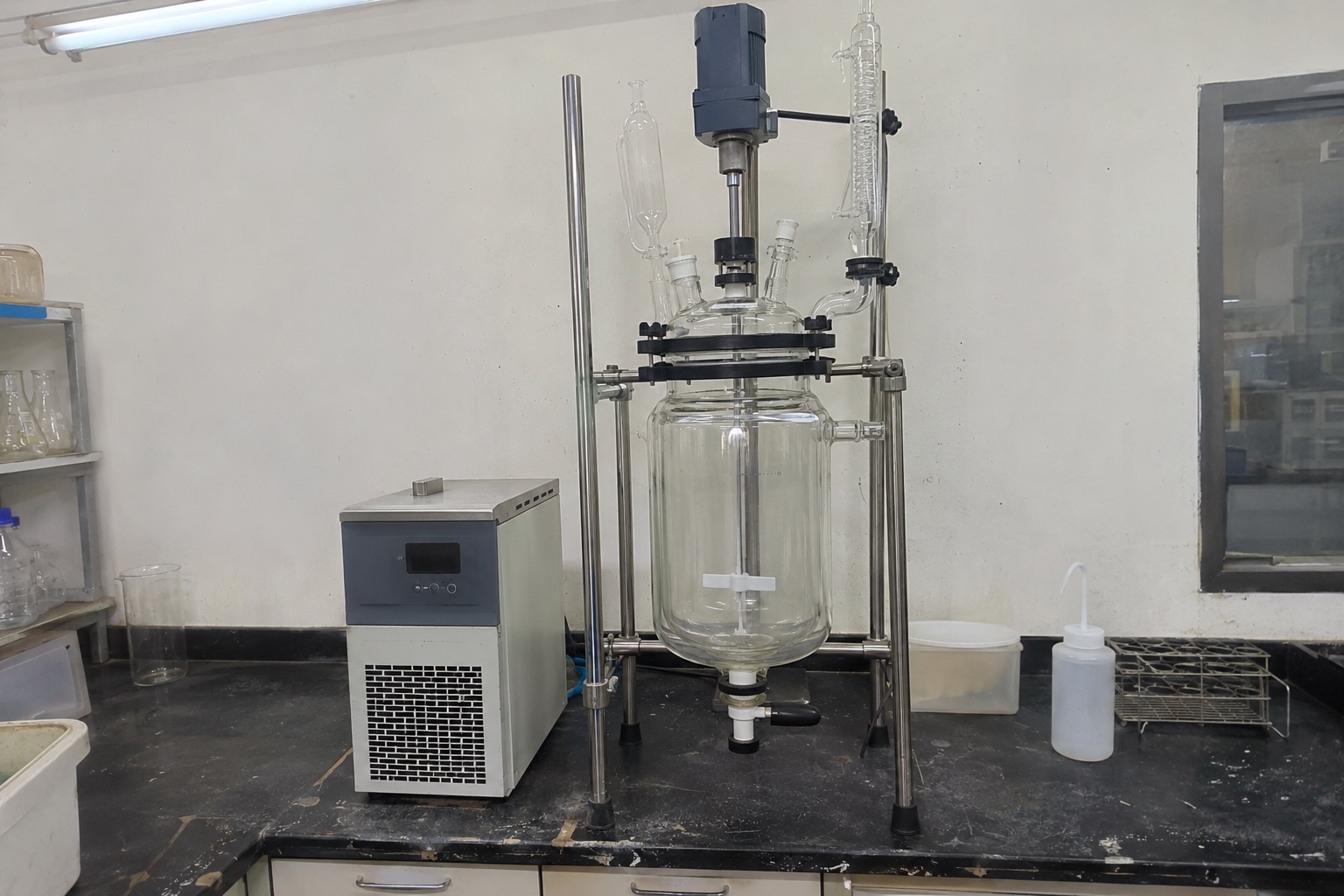
Choosing a jacketed glass reactor for winterization or crystallization starts with the process, not the catalog page. The vessel size is the easiest number to compare, and it is also the number most likely to mislead a purchase: a reactor that holds the batch is not automatically a reactor that can hold the temperature, stir the contents, and hand the material on to the next step without rework.
This guide explains what to specify before selecting a reactor, in the order a buyer and a process owner usually need to answer the questions. It provides a specification checklist rather than a model recommendation or a validated operating procedure. Final selection should use the proposed model’s documented specifications, the equipment manual, and the site’s installation requirements.
Quick answer
For winterization and crystallization, specify four things together before comparing models:
- Working volume, not just vessel volume. State the batch size and the working fill level, with room left for agitation, reflux or condenser return, and safe handling.
- Jacket temperature window and control. State the lowest and highest jacket temperatures the process requires, how fast the temperature must change, and how tightly it must be held.
- Agitation for the actual material. State viscosity, solids content, and whether crystals or precipitates will form during the run.
- Heating and cooling pairing. State what will drive the jacket — a recirculating chiller, a heating/cooling circulator, or both — and what capacity it can deliver at the working temperature.
A reactor selected on vessel volume alone can still fail the job if the jacket cannot reach the working temperature under load, if the stirrer cannot move the material once it thickens, or if the next step — filtration, centrifugation, or distillation — was never included in the specification.
What batch size actually means
Specify nominal vessel volume and permitted working volume separately. Ask for the proposed model’s documented fill limits, materials of construction and configuration.
Useful questions for the batch-size decision:
- What is the batch volume, and what working fill level does the approved procedure allow? A vessel run close to full leaves little room for agitation effects, foaming, or additions.
- Will the same vessel be used for more than one step — for example, winterization followed by a hold, a transfer, or a crystallization — or will material be moved between vessels?
- How does the batch change during the run? A solution that starts free-flowing and then throws out solids behaves differently at the end of the run than at the start.
- What happens on scale-up? Moving from a 10L or 20L lab vessel to a 50L or 100L pilot vessel changes heat-transfer area per unit volume, mixing time, and the time needed to reach a set temperature. Do not assume that a procedure that works at lab scale will behave identically at pilot scale without a documented scale-up check.
Treat an unknown value as an item to confirm, rather than replacing it with an assumed standard setup.
Jacket temperature range and control
Specify the jacket temperature window from the process requirements. A temperature range listed for a circulator is not, by itself, a validated operating range for the complete reactor assembly. Confirm limits for the glass vessel, jacket, seals, hoses and heat-transfer fluid separately.
When specifying the jacket, state the following together:
- The lowest jacket temperature the process requires, and for how long it must be held
- The highest jacket temperature, if the same vessel will also be used for heating, dissolution, or a temperature ramp
- The required ramp rate, if the procedure depends on a controlled cooling or heating profile
- How temperature will be measured and controlled: jacket fluid temperature, internal contents temperature, or both, and what tolerance the procedure allows
A lower minimum-temperature rating, by itself, does not demonstrate a better match. A circulator that reaches a very low temperature with no load may still be unable to hold that temperature once a full, warm batch is connected to the jacket. JULABO explains that heating/cooling duty calculations must consider the material, temperature change, time and connected system inventory. Its fluid guidance also identifies viscosity as a factor in circulation performance. [1][2] The same logic that applies to chiller selection — capacity at the working temperature matters, not only the nameplate minimum — applies here, and it is covered in detail in the site’s chiller guide for rotary evaporators.
If the process needs both deep cooling and heating in one loop, a heating/cooling circulator is the pairing to evaluate. If it needs cooling only, a recirculating chiller may be sufficient. State the pairing in the inquiry; do not leave it for the supplier to guess.
Agitation, viscosity and solids
Crystallization and winterization both change the material during the run. A stirrer that is adequate for a clear, low-viscosity solution at the start may be inadequate once waxes precipitate, crystals grow, or viscosity rises.
Before selecting, record:
- The material’s viscosity range across the run, if known, or a description of how it changes
- Whether solids form, settle, or need to stay suspended
- Whether the procedure requires gentle mixing, vigorous mixing, or a specific stirrer geometry
- Whether probes, dosing lines, or sampling ports must share the vessel head with the stirrer
Request the stirrer geometry, wetted materials, drain dimensions and port layout for the quoted model. If lifting is needed for cleaning or transfer, ask for the documented lifting arrangement and its operating restrictions. Do not assume every size shares the same configuration.
Heating and cooling pairing checklist
Use this table in the inquiry. It mirrors the checklist approach in the site’s chiller guide, so the reactor inquiry and the chiller inquiry do not contradict each other.
| Information to provide | Question it helps resolve |
|---|---|
| Batch volume and working fill level | What vessel size and jacket area must be assessed? |
| Target jacket temperature window and hold time | What cooling and heating duty must be assessed over the run? |
| Required ramp rate, if any | Is a programmable circulator needed, or is a fixed setpoint sufficient? |
| Solvent or media identity | What chemical compatibility and safety review is needed? |
| Viscosity and solids behaviour | What agitation and drain configuration is needed? |
| Existing heating/cooling equipment, if any | Can the new reactor use an existing loop, or must a circulator be quoted with it? |
| Facility power supply | What voltage and phase configuration must be quoted? |
| Hazardous-area classification, if applicable | What explosion-proof configuration scope must be assessed? |
When comparing quotations, request:
- Cooling and heating capacity in watts at the proposed jacket setpoint, not only at the circulator’s rated extremes
- The ambient temperature and coolant or heat-transfer fluid used for that rating
- Whether the quoted capacity covers the jacket loop alone or the jacket plus any condenser or secondary loop
- Evidence supporting the proposed pairing under the specified process load — a calculation, a published specification, or a measured test result, identified as such
Reaching a temperature without a connected process load does not establish suitability for the intended duty.
Vacuum, pressure and safety inputs
Some winterization and crystallization procedures run under vacuum; others do not. Do not assume either case. State in the inquiry whether vacuum will be applied, what pressure range is required, and whether the vessel, seals, and connected equipment are rated for that condition in the manufacturer’s documentation.
For solvent handling, provide the solvent identity and any documented site hazardous-area classification. Request the model-specific electrical and site-suitability documentation required by the facility review. An “explosion-proof” product label alone does not establish suitability for a particular installation. Confirm facility voltage, frequency and phase against the proposed equipment documentation before ordering.
What usually goes wrong
The following are specification gaps to check before ordering:
- Volume without a temperature window. The vessel fits the batch, but the jacket loop cannot hold the winterization temperature under load.
- Temperature without a ramp. The circulator reaches the setpoint eventually, but the procedure needed a controlled cooling profile and the control package does not provide it.
- Agitation without a solids plan. The stirrer handles the starting solution, but not the material once crystals or precipitates form, and draining becomes the bottleneck.
- A reactor quoted without its loop. The vessel is priced alone, and the chiller or heating/cooling circulator, hoses, fittings, and control package arrive as a second, unbudgeted decision.
- A hazardous-area scope quoted without a facility determination. The configuration is ordered before the AHJ classification is confirmed, and the scope must be revised.
Sending the checklist with the first inquiry can help identify these gaps before a configuration is agreed.
Before requesting a quotation
Send the supplier the batch and working volume, the jacket temperature window and hold time, the solvent or media, the viscosity and solids behaviour, the agitation and drain requirements, the existing heating/cooling equipment (if any), the facility power supply, the hazardous-area classification, and the destination. Request any required site-suitability documentation separately; temperature and capacity ratings do not establish suitability for a hazardous location.
You can review the jacketed glass reactor category, the recirculating chiller category, and the chiller & heater category, or send a configuration inquiry. For background on the cooling side of the same workflow, see How to Choose a Chiller for a Rotary Evaporator; for vacuum problems on a connected evaporation step, see Rotary Evaporator Not Reaching Vacuum? 5 Causes and Fixes.
Frequently asked questions
Does a bigger reactor always winterize faster? Not necessarily. A larger vessel holds more material, but it also changes heat-transfer area per unit volume and the time needed to bring the full batch to temperature. Faster winterization depends on the jacket loop’s capacity at the working temperature, the batch size, and the hold time in the approved procedure — not on vessel volume alone.
Does winterization always need −80 °C? No. The required temperature window comes from the process file for the material being processed. A lower minimum-temperature rating does not, by itself, demonstrate a better match; what matters is whether the proposed jacket loop can hold the required temperature under the actual process load.
Can the same reactor be used for winterization and crystallization? It can be, in many workflows, provided the vessel, stirrer, drain, and jacket loop are specified for both steps: the temperature window, the solids behaviour, and the cleaning requirements of each step. If the two steps have very different temperature or agitation requirements, state both in the inquiry so the quoted configuration can be checked against each one.
How is an explosion-proof version decided? By the facility’s hazardous-area determination and the solvent class, reviewed with the authority having jurisdiction and the customer’s facility review. Send that determination with the inquiry; the quoted explosion-proof scope — motor, control box, and related components — should be matched to it, not assumed.
Notes on this guide
- This article is a selection guide, not an operating procedure. The equipment manual and the laboratory’s approved procedure govern operating settings.
- Model specifications, chemical compatibility, electrical requirements and installation suitability must be confirmed from the proposed configuration’s documentation. This guide makes no certification or performance claim for an LM Scientific model.
- References to third-party concepts (for example, authority having jurisdiction) identify a review step; they do not imply endorsement, affiliation, or certification of LM Scientific products.
- Buyers are responsible for confirming that their local processing activity is permitted and lawful in their jurisdiction; equipment is sold for general laboratory and extraction use.
Technical references
- JULABO USA — Glossary: heating and cooling capacity calculations.
- JULABO USA — How Bath Fluid Viscosity Affects Temperature Applications.
Sources accessed November 4, 2026. These references support general temperature-control considerations; they do not validate LM Scientific equipment performance or imply endorsement.