
Rotary Evaporator
Rotary Evaporator Not Reaching Vacuum? 5 Causes and Fixes
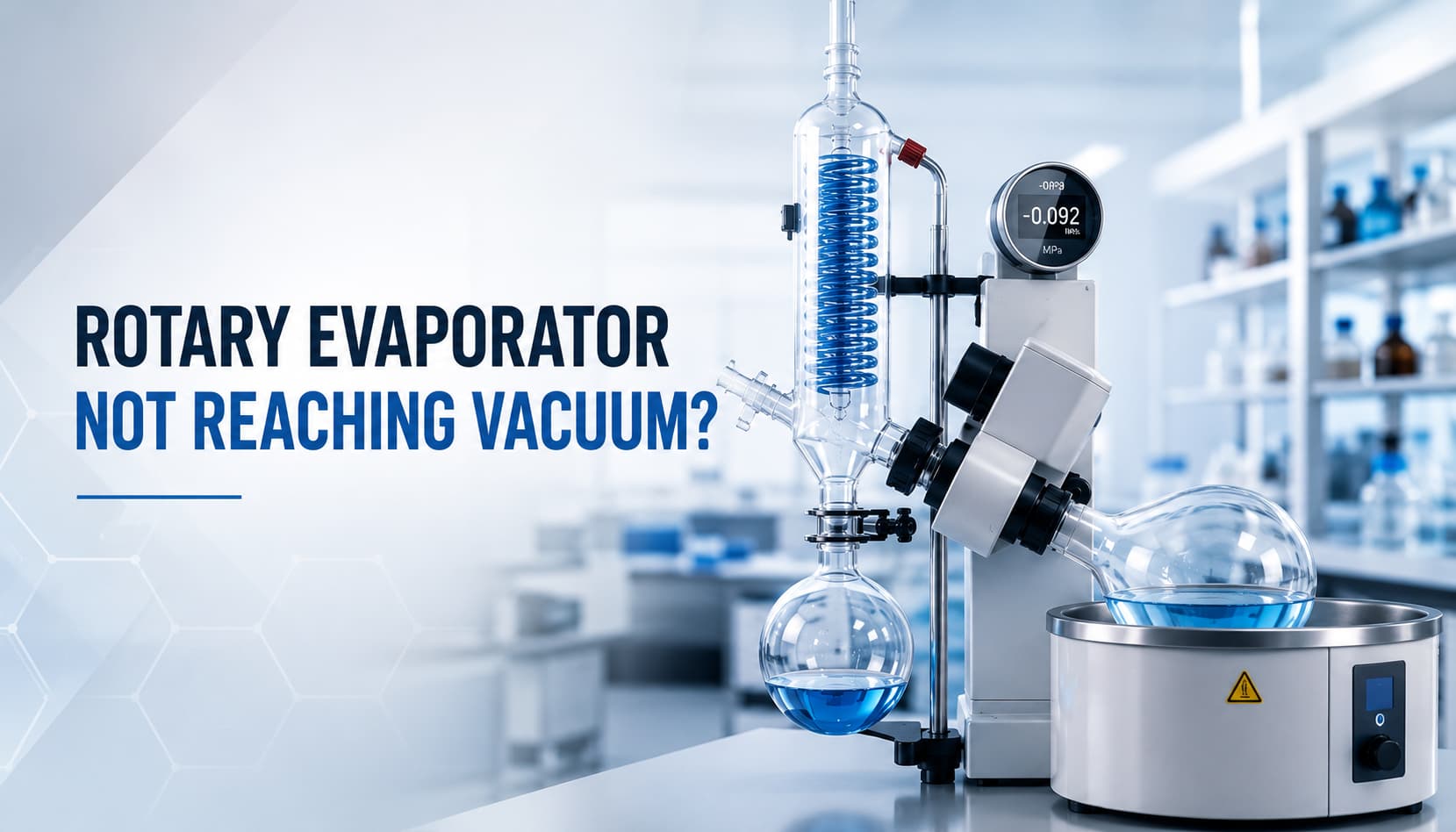
A practical rotary evaporator vacuum troubleshooting guide for laboratory users and equipment buyers
When a rotary evaporator is not reaching vacuum—or reaches the set point but cannot hold it—evaporation slows, solvent recovery becomes unstable, and the vacuum pump may run continuously. The pump itself is only one possible cause. A rotary evaporation system also depends on airtight glassware, compatible seals, sufficient condenser capacity, suitable operating settings, and an accurate pressure measurement.
The fastest way to solve the problem is to separate the vacuum system from the evaporation process. First test the pump and empty system; then add cooling, solvent, and heat one variable at a time. The five sections below cover the most common causes and the checks that provide useful evidence before parts are replaced.
QUICK ANSWER The five most common reasons a rotary evaporator cannot reach the required vacuum are air leaks, an unsuitable or poorly maintained vacuum pump, insufficient condensation, excessive vapor generation, and an inaccurate vacuum reading. Air leaks should normally be checked first.
Quick Rotary Evaporator Vacuum Troubleshooting Table
| Symptom | Likely cause | First check |
|---|---|---|
| Pressure rises after the pump is isolated | Air entering the system | Run a pressure-rise leak test and isolate sections |
| Pump reaches its specification alone but not on the evaporator | System leak or flow restriction | Inspect seals, joints, hoses, valves and line diameter |
| Vacuum worsens only when boiling begins | Vapor load exceeds condensation or pumping capacity | Reduce heat input and verify coolant temperature and flow |
| Vacuum becomes worse as a water reservoir warms | Water-circulating pump performance is falling | Refresh/cool the water and compare with the pump curve |
| Displayed pressure conflicts with process behavior | Gauge, location or calibration problem | Check the sensor against a known reference |
1. Air Leaks in the Rotary Evaporator Vacuum System
Air leakage is the most common reason a rotary evaporator is not holding vacuum. Because pressure is the result of gas entering and leaving the system, even a small leak can prevent the pump from reaching the target pressure under process conditions.
Where to Check for a Rotavap Vacuum Leak
- Ground-glass joints that are dry, contaminated, misaligned, or insufficiently greased when grease sealing is required
- PTFE seals, O-rings, gaskets, and vapor-duct seals that are worn, hardened, scratched, or installed incorrectly
- Vacuum hoses that are loose, kinked, permeable, cracked, or softened by solvent exposure
- Vacuum valves, controller connections, receiving-flask joints, and drain valves that are not fully closed
- Glassware with chips, star cracks, or hairline damage around joints and flanges
How to Perform a Basic Leak Test
Use a clean, dry, empty system. Evacuate it to a defined pressure, isolate the pump, and record the pressure rise over a fixed period—commonly 60 seconds. Some rotary evaporator manufacturers use approximately 50 mbar as a test point, but the acceptable leak rate must come from the equipment manual. If pressure rises too quickly, isolate the pump, controller, condenser, receiving flask, and evaporation side in stages. The section whose removal sharply reduces the pressure rise contains the likely leak.
A blank-off test at the pump inlet is also useful. If the pump cannot approach its own specification when disconnected from the rotary evaporator, investigate the pump before continuing with the glassware.
2. Vacuum Pump Selection or Maintenance Problems
A vacuum pump for a rotary evaporator must provide both the required operating pressure and sufficient pumping speed at that pressure. Do not select only by the lowest ‘ultimate vacuum’ number on the data sheet. Ultimate pressure is normally measured with little process gas, whereas a working rotary evaporator continuously produces solvent vapor.
Use Absolute Pressure for Technical Comparison
Negative gauge values such as −0.09 MPa can be convenient for operators, but they change with atmospheric pressure and are easy to misinterpret. For pump selection and solvent boiling data, use absolute pressure in mbar, hPa, Torr, or kPa(abs). Compare the pump curve at the required working pressure, not only its ultimate pressure.
Common Pump Options
- Chemical-resistant diaphragm pump: A common choice for laboratory rotary evaporation because it is oil-free and available with solvent-resistant wetted parts and speed control. Verify ultimate pressure and capacity for the solvent and flask size.
- Water-circulating vacuum pump: Economical for moderate vacuum, but achievable pressure depends strongly on water temperature, water quality, and the vapor pressure of the operating liquid. It may be unsuitable for deeper-vacuum work or high-boiling solvents.
- Oil-sealed rotary vane pump: Can provide deeper rough vacuum, but solvent and water can contaminate the oil. A correctly sized condenser or cold trap, suitable gas-ballast operation, exhaust filtration, and disciplined oil maintenance are essential.
Vacuum Pump Maintenance Checklist
- Confirm the pump reaches its blank-off pressure and compare the result with the manufacturer’s specification.
- For water-circulating pumps, check reservoir level and temperature, scale buildup, inlet blockage, impeller condition, and the non-return valve.
- For rotary vane pumps, inspect oil level, color, viscosity, emulsification, solvent contamination, inlet/exhaust filters, vanes, and gas-ballast settings.
- For diaphragm pumps, inspect diaphragms, valves, head seals, condensate separators, and any speed-control or solenoid valve faults.
High-boiling solvents such as DMSO and DMF often require deeper operating pressure and strong condenser performance. If the selected pump cannot maintain the required pressure under vapor load, this is an application-matching problem rather than a pump failure.
3. Condenser or Cold-Trap Problems Increase Vapor Load
The condenser protects the rotary evaporator vacuum pump by removing most condensable vapor before it reaches the pump. If cooling is insufficient, vapor passes through the condenser, system pressure rises, solvent recovery falls, and pump maintenance increases.
Check the following:
- The recirculating chiller is running, has adequate cooling capacity, and can maintain its set point under the actual heat load.
- Coolant temperature is sufficiently below the solvent-vapor temperature at the operating pressure. A temperature difference of about 20°C is a common starting guideline, but solvent data and the equipment manual take priority.
- Coolant flow direction, flow rate, hose routing, and condenser fill follow the manufacturer’s instructions.
- Ice, frozen condensate, or contamination is not restricting the vapor path or coolant circuit.
- The receiving flask, cold trap, and exhaust condenser are not full, blocked, or creating excessive flow resistance.
A colder set point alone is not always the solution. If the chiller lacks capacity or the condenser area is too small for the evaporation rate, its actual temperature will rise even though the display still shows the requested set point.
4. Operating Conditions Generate More Vapor Than the System Can Handle
If the empty rotary evaporator passes a leak test but vacuum deteriorates when the sample begins to boil, the system is probably facing excessive vapor load rather than a static air leak.
Heat Input and Pressure Reduction Are Too Aggressive
Excessive bath temperature, a rapid vacuum ramp, or a large increase in evaporation area can generate vapor faster than the condenser and pump can remove it. The result is higher system pressure, bumping, foaming, sample carryover, and an unstable vacuum reading. Reduce pressure gradually, moderate heat input, and use controlled vacuum rather than pulling the deepest available vacuum immediately.
The Sample Contains Water or Highly Volatile Components
Water-rich or mixed-solvent samples may create a sustained or changing vapor load. Select the vacuum set point from the solvent boiling behavior and bath temperature, then confirm that the condenser and pump can handle the expected mass flow. When appropriate, remove excess water first or add a correctly sized cold trap; do not use a trap that creates an unacceptable restriction or freezes shut.
The Evaporation Flask Is Overfilled
The correct filling level depends on the solvent, foaming tendency, flask geometry, and manufacturer guidance. A working fill of roughly 30–50% is common; approximately 40% is a conservative starting point for samples that may foam. Excess filling reduces vapor space and increases the risk of foaming, liquid carryover, sudden vapor surges, and unstable vacuum performance.
5. The Vacuum Gauge or Sensor Is Giving a Misleading Reading
The system may have reached the required pressure even when the displayed value suggests otherwise. Vacuum sensor drift, contamination, an overdue calibration, a damaged gauge, a blocked pressure port, or poor sensor placement can all produce a misleading result.
- Confirm whether the display reports absolute pressure or negative gauge pressure.
- Inspect the sensor port and tubing for condensate, residue, or isolation valves left closed.
- Compare the reading with a calibrated reference gauge at the same measurement location.
- Check the sensor’s chemical compatibility, calibration interval, zero function, and specified pressure range.
Sensor location matters: pressure at the pump inlet may differ from pressure inside the evaporator when hoses, valves, traps, or condensers restrict flow.
A Five-Step Diagnostic Sequence
- Test the vacuum pump alone. Run a blank-off test and compare the pressure with the pump specification.
- Test the empty, dry rotary evaporator. Run a pressure-rise leak test with the pump isolated.
- Verify the cooling system. Measure actual coolant temperature and confirm flow and capacity under load.
- Add the process gradually. Start with a small solvent load, a moderate bath temperature, and a controlled pressure ramp.
- Verify the measurement. Check gauge type, location, contamination, and calibration before replacing major components.
Stable Vacuum Starts with the Whole System
When a rotary evaporator is not reaching the required vacuum, check the entire system in a logical order: pump capability, air tightness, condensation, process load, and pressure measurement. This approach prevents unnecessary part replacement and helps restore faster evaporation, higher solvent recovery, more repeatable results, and safer operation.
Not sure which rotary evaporator system is right for your application? Contact the LM Scientific technical team with your process requirements, and we’ll help you configure the optimal solution for maximum efficiency and reliable performance.